

Tools
Astronomy glossary
The 86 words that come up in the entries, the captions and the apps. Each definition opens with a plain sentence. The detail comes afterwards. It is written for someone who has just opened their first smart telescope, not for a seasoned astronomer.
By Gus
A
- Abell
-
A catalogue of 86 planetary nebulae, drawn up by George Abell in 1966. These objects are very faint, and they are kept for the end of the road. The same author published a second catalogue, devoted to clusters of galaxies.
- Alignement
-
The instrument looks at the stars in front of it and recognises them. From that it works out which way it is pointing. On a smart telescope, the operation is automatic and takes a few seconds.
See also Résolution astrométrique
- Altaz
-
Short for altazimuth, the other name for the azimuthal mount: one axis for height, or altitude, one axis for direction, or azimuth.
Read the full definition
An altaz, or altazimuth, mount is a support for a telescope or refractor that lets the instrument be pointed along two perpendicular axes: altitude (vertical axis, up and down) and azimuth (horizontal axis, left to right). It is the simplest and most intuitive system: it works exactly like an ordinary photo tripod, or like the famous Dobsonian telescopes.
The strengths
- Ease of use: it is extremely intuitive. You just point the tube up, down, left or right to target an object.
- No complex setting up: unlike an equatorial mount, it needs no polar alignment and no alignment on the pole star before observing begins.
- Light and compact: lighter and generally without counterweights, it sets up in a few seconds, which makes it the ideal tool for beginners or for impromptu observing sessions.
- Versatility: it suits astronomical observing as well as terrestrial observing (nature, landscapes, birds).
The limits
- Tedious manual tracking: as the Earth turns, celestial objects seem to move across the sky diagonally, in an arc. Without a motor, the position has to be corrected constantly on both axes at once to keep the object in the centre of the eyepiece.
- Unsuited to long exposure astrophotography: even motorised (GoTo system), it causes a phenomenon called field rotation, the stars turning around the centre of the image. It is therefore limited to visual use or to very short exposure photography (Moon, planets).
See also Azimutale (monture) Rotation de champ Équatoriale (monture)
- Amas globulaire
-
A ball of several hundred thousand very old stars. It orbits a galaxy. The Milky Way holds about 160 of them.
- Amas ouvert
-
A group of young stars, born together and still loosely packed. It holds anything from a few dozen to a few thousand. About 1,100 are recorded in our galaxy. The Pleiades are the best known example.
- Amp glow
-
A coloured halo in a corner of the image, produced by the heat of the sensor electronics. It grows with the length of the exposure and with temperature. Recent sensors produce little of it, and the dark takes it away.
See also Capteur CMOS Dark (image de)
- Année-lumière
-
The distance light travels in one year. It is used to state the distance of deep sky objects. To see an object a thousand light-years away is to see it as it was a thousand years ago.
See also Ciel profond
- Aphélie
-
The point on the orbit of a planet or a comet that is furthest from the Sun, where it moves slowest. The Earth passes it in early July: in 2026, on 6 July at 19:31, official French time, at 1.017 astronomical units, about 152 million kilometres. It is high summer in the northern hemisphere: the distance from the Sun does not make the seasons.
Read the full definition
Main characteristics
- Origin of the word: from the Greek apo (far) and Helios (sun).
- Opposite: perihelion, which is the point closest to the Sun.
- Speed: at aphelion, the object's speed along its orbit is at its lowest.
The example of the Earth
- Distance: about 152 million kilometres, against 147 million kilometres at perihelion.
- Date: every year at the beginning of July, for example on 6 July 2026.
- Seasons: the Earth's distance at aphelion, in early July, does not create winter; the seasons depend only on the tilt of the Earth's axis.
Sources:
See also Périhélie
- Ascension droite
-
The first of the two coordinates that place an object in the sky. It is the equivalent of longitude, projected onto the sky. It is counted in hours, minutes and seconds, from 0 to 24h.
See also Déclinaison
- Astéroïde
-
A small rocky or metallic body that orbits the Sun, left over from the formation of the solar system. That was about 4.6 billion years ago. Most of them travel between Mars and Jupiter, in the main belt. An asteroid has none of the activity of a comet: no coma and no tail. Through a telescope, it looks like a star, and it can only be told apart because it moves against the stars.
Read the full definition
It is a rocky, carbonaceous or metallic celestial body that orbits the Sun, and whose size ranges from a few metres to several hundred kilometres. Smaller than the planets, asteroids are seen as “leftovers”, unused building blocks dating from the formation of the solar system, about 4.6 billion years ago.
Where are they found?
The vast majority of asteroids orbit in well defined zones of the solar system:
- The main belt: lying between Mars and Jupiter, it holds millions of asteroids.
- The Trojans: they share the orbit of a planet, mainly Jupiter, and travel ahead of it or behind it, at the Lagrange points.
- Near-Earth asteroids (NEAs): asteroids whose orbit crosses that of the Earth, which makes them objects watched particularly closely by space agencies.
Composition and classification
Astronomers sort asteroids into three broad families according to their composition, which their light spectrum reveals:
- C type (carbonaceous): the most common, about 75%. They are very dark and rich in carbon.
- S type (silicates): made of rock (silicates) and iron-nickel, they account for about 17% of asteroids.
- M type (metallic): made almost entirely of iron and nickel, they often come from the molten core of large former celestial bodies that were destroyed.
What sets them apart from other celestial bodies
- Asteroid or comet: the asteroid is rocky or metallic and shows no activity. The comet is a body of ice and dust, which develops a coma and a tail as it comes close to the Sun.
- Asteroid or meteoroid: a meteoroid is simply a very small asteroid, from 30 micrometres to about 1 metre according to the International Astronomical Union. If it passes through the Earth's atmosphere, it becomes a meteor, a shooting star; if it reaches the ground, a meteorite.
- The case of Ceres: the largest object in the main belt, about 940 km across, Ceres was long classed as the largest asteroid, before being reclassified as a dwarf planet in 2006 because of its spherical shape.
- Astre
-
Any natural celestial body: a star, a planet, a satellite such as the Moon, an asteroid or a comet. The word leaves out what humans have launched, artificial satellites and space stations.
- Azimutale (monture)
-
A mount that moves up and down and left and right. It is also called altazimuth, or altaz. It is simple and compact. But it makes the field rotate as the night goes on, so sub-exposures stay short, unless a field derotator follows that rotation during the exposure: with its own derotator and its autoguiding, the DWARF Draco is announced at 300 seconds per exposure. The Vespera models from Vaonis, which have no derotator, keep exposures in which the rotation does not show, and make up for it at stacking.
Sources:
See also Équatoriale (monture) Rotation de champ
B
- Bias
-
The English name for the offset frame, for exactly the same thing. The word circulates in French because the processing software is in English and calls that batch of exposures by that name. A second sense exists, with nothing to do with calibration: the Malmquist bias, which means that far away, only the brightest objects are still detected.
Read the full definition
In astrophotography: the offset frame
In digital deep sky imaging, the bias is an essential calibration frame for cleaning up raw shots.
What it is: the electronic read noise the sensor, CCD or CMOS, generates at the exact moment it transmits the image data. Even in absolute darkness and with zero exposure time, the sensor does not show a value of 0 on its pixels: it applies a slight constant offset, the bias, together with small electronic variations.
How to take it: you take between 20 and 50 photographs in total darkness, cap on the lens, with the shortest exposure time the camera allows, for example 1/4000 s or 1/8000 s. The ISO, or the gain, must stay strictly the same as for the photographs of the sky.
What it is for: combining these frames gives a Master Bias, which stacking software subtracts from the raw frames to remove this fixed spurious signal.
In observational astronomy: the Malmquist bias
In cosmology and in the study of stars, the word refers to a statistical selection phenomenon, described by the astronomer Gunnar Malmquist.
What it is: a selection bias, which arises when studying samples of objects limited by their apparent brightness.
The problem: the further away an object is, star or galaxy, the fainter it looks to us. At great distances, our telescopes therefore detect only intrinsically very bright objects, such as giants or supernovae, while fainter objects become invisible.
The consequence: if you are not careful, you can skew the statistical conclusions, thinking that distant stars are on average more luminous than nearby stars, when it is simply an optical selection effect.
See also Offset (image d') Empilement
- Binning
-
Neighbouring pixels are grouped in squares, most often two by two, to make one single pixel. The image loses resolution but gains sensitivity. It is useful on faint objects and under a mediocre sky.
See also Capteur CMOS Échantillonnage
- Bloat
-
The English word for the swelling of stars in an image: instead of fine points, they come out big and soft, surrounded by a halo. It often comes from light that the optics do not bring to focus with the rest, the infrared or ultraviolet that a UV/IR-cut filter would have stopped; imperfect focusing or atmospheric turbulence make it worse. In astrophysics, the same word describes abnormally swollen planets or stars, with no connection to the image.
Read the full definition
In astronomy and astrophotography, the term bloat, or bloating, refers to a phenomenon of abnormal swelling or expansion of a celestial object. It is not an official classification of the International Astronomical Union, but a physical or technical descriptor, used in two very specific contexts.
In astrophotography: star bloat, or the widening of stars
Star bloat is the flaw by which stars appear abnormally large, blurred or smeared on an image. Instead of sharp, precise points of light, the light bleeds. This technical problem has three causes:
- Infrared (IR) radiation: the sensors of digital cameras are very sensitive to the infrared given out by stars. Without a cut filter (UV/IR-cut), infrared wavelengths focus differently from visible light, which makes the star “swell” on the image.
- Optical aberrations: in particular spherical aberration, or the chromatic aberration of lower quality refractors (doublets), which spread the light around the centre of the star.
- Atmospheric turbulence or poor focus: an unstable atmosphere, or a focus that is slightly off, widens the profile of the star.
In astrophysics: “bloated” celestial bodies
Researchers use the adjective bloated to describe objects that undergo a massive expansion in volume compared with their normal mass:
- Bloated exoplanets, also called puffy planets: these are gas giants, often “hot Jupiters”, which orbit extremely close to their star. Heated white hot by the star's intense radiation or by internal tidal effects, the gas layers of their atmosphere expand massively. These planets show a gigantic radius, sometimes larger than Jupiter's, but an abnormally low density, similar to that of polystyrene or cork.
- Stars in a phase of active accretion (bloated stars): during the formation of very large stars, the ultra fast fall of the surrounding matter onto the protostar releases so much energy that the surface of the star starts to swell out of all proportion. Its surface temperature drops temporarily, which makes it hard to detect with traditional radio waves.
See also Filtre (types de) Seeing
- Bortle (échelle de)
-
The scale that says how dark the sky is, from 1 to 9. Class 1 is a sky with no trace of artificial light at all; class 9 is a city centre. It is read with the naked eye, by looking for the faintest star still made out. It is the best explanation for why two images of the same object, taken with the same device, do not look alike.
-
Class 1, Excellent dark sky
Limiting magnitude 7.6 to 8.0 · SQM 21.76 to 22.0
A sky untouched by any artificial light. The Milky Way casts a shadow on the ground.
-
Class 2, Typical truly dark sky
Limiting magnitude 7.1 to 7.5 · SQM 21.6 to 21.75
A highly structured Milky Way, a faint halo near the horizon.
-
Class 3, Rural sky
Limiting magnitude 6.6 to 7.0 · SQM 21.3 to 21.6
First signs of light pollution on the horizon, the zenith still dark.
-
Class 4, Rural to suburban transition
Limiting magnitude 6.1 to 6.5 · SQM not published
Domes of light pollution visible on the horizon, above the towns.
-
Class 5, Suburban sky
Limiting magnitude 5.6 to 6.0 · SQM 19.25 to 20.3
The Milky Way barely discernible, a halo over almost the whole horizon.
-
Class 6, Bright suburban sky
Limiting magnitude 5.1 to 5.5 · SQM 18.5 to 19.25
Zodiacal light invisible, the Milky Way visible only at the zenith.
-
Class 7, Suburban to urban transition
Limiting magnitude 4.6 to 5.0 · SQM 18.0 to 18.5
A tinted grey sky in every direction, the Milky Way invisible.
-
Class 8, City sky
Limiting magnitude 4.1 to 4.5 · SQM less than 18.0
Newspaper headlines can be read without a light.
-
Class 9, Inner-city sky
Limiting magnitude less than 4.0 · SQM less than 18.0
Hardly a star left, apart from the Moon and the planets.
The 9 classes follow at a constant step, 0.5 point of magnitude each. That is what the top row shows, and that is why it is even. The bottom row measures the same thing with an instrument, and it is not even at all. The step of the eye and the step of the instrument do not line up, which is the reason for having two measurements.
What this drawing does not claim. The gap in the bottom row is an absence, not a sky: the source that publishes the brightness values splits class 4 in two and gives nothing for the class as a whole. The muted blocks on the right are open bounds: “less than 4.0” and “less than 18.0” have no floor, and their width is drawn, not measured. The SQM brightness values, lastly, are given as approximate by the source that publishes them, and the original 2001 scale had no SQM column at all.
John E. Bortle, « Introducing the Bortle Dark-Sky Scale », Sky & Telescope, février 2001 · Wikipédia, Échelle de Bortle · Wikipedia, Bortle scale, colonne « Approx. SQM »
See also Pollution lumineuse Magnitude limite Duo-bande (filtre)
-
C
- Caldwell
-
A catalogue of 109 bright objects, drawn up by Patrick Moore in 1995. They are objects absent from the Messier catalogue. It is the right next step once the easy Messiers are used up.
- Capteur CMOS
-
The light sensitive surface, which takes the place of the eye and of film. Three things count: its sensitivity, the size of its pixels and its noise. They decide what the instrument can reach, far more than the diameter does.
- Champ (de vision)
-
What the device sees at one go, measured in degrees. The full Moon is about half a degree. A field of 3° therefore holds six full Moons side by side.
- Champ apparent
-
The angle the image takes up for the eye looking into an eyepiece, as opposed to the piece of sky actually covered. The distinction comes from visual observing. A smart telescope has no eyepiece: on this site, the field quoted is always the true field.
See also Champ (de vision)
- Ciel profond
-
Everything that lies outside the solar system: nebulae, galaxies, clusters. These objects are faint and spread out. They are made for the long exposure, not for the eye.
- Collimation
-
The adjustment that puts the mirrors or the lenses back square on the axis. Smart telescopes are sealed and do not need it. Only large diameters with an open tube still have to be adjusted.
- Comète
-
A ball of ice and dust: close to the Sun, its ice sublimates and releases gas and dust, which form a coma around the nucleus, then two tails, one of dust, the other of ionised gas, which sunlight and the solar wind push back. It moves against the stars during the exposure, so much so that the stacking has to choose: locking on the stars stretches the comet, locking on the comet stretches the stars.
Read the full definition
It is a small celestial body made of ice, dust and rock, which orbits the Sun on paths that are generally very elongated (elliptical). Unlike asteroids, which are purely rocky or metallic, comets are often compared to “dirty snowballs”. When they come close to the Sun, the heat makes their ice sublimate, passing straight from the solid state to the gaseous state: a bright envelope forms, along with long, characteristic trails of light.
The structure of a comet
An active comet is made up of several distinct parts:
- The nucleus: the solid, central part of the comet, which generally measures from a few hundred metres to a few tens of kilometres. It is made of ices (water, carbon monoxide, methane) and dust.
- The coma: a spherical cloud of gas and dust that surrounds the nucleus when the ice starts to sublimate under the effect of solar radiation.
The tails: a comet generally develops two distinct tails as it comes close to the Sun, always pointing away from the Sun because of the solar wind:
- The dust tail: white or yellowish, curved, it is pushed by the pressure of sunlight.
- The ionised gas tail: bluish, very straight, it is pushed back directly by the magnetic solar wind.
Where do comets come from?
Comets come from the icy outer reaches of the solar system, mainly from two reservoirs:
- The Kuiper belt: lying beyond the orbit of Neptune, it is home to short period comets, which take less than 200 years to go round the Sun, such as the famous Halley's Comet.
- The Oort cloud: an immense sphere of icy bodies that surrounds the solar system at a gigantic distance. It is the source of long period comets, whose orbit can take thousands or even millions of years.
What sets them apart from other bodies
- Comet or asteroid: the comet contains volatile ices and becomes active (it outgasses) near the Sun, whereas the asteroid is inert, made of rock or metal.
- The link with shooting stars: a comet leaves a cloud of dust behind it along its orbit. When the Earth passes through this cloud of debris, the grains enter the atmosphere and burn up: these are meteor showers, such as the Perseids in August.
See also Suivi Empilement Temps d'intégration Messier Astéroïde Météorite
- Coordonnées équatoriales
-
The frame of reference that places an object in the sky the way longitude and latitude place a location on Earth. It starts from the celestial equator, the extension of the Earth's equator, and counts two coordinates: right ascension and declination. They depend neither on the place nor on the time of observation, and that is why catalogues give them.
- Crépuscule
-
The time when the Sun has set but still lights the sky through the atmosphere. It is divided into three according to how far the centre of the Sun is below the horizon: civil down to 6°, nautical down to 12°, astronomical down to 18°. Beyond that begins astronomical night, the only time when the faintest deep sky can be photographed without the glow of the Sun.
Read the full definition
It refers to the period of luminous transition between sunset, or sunrise, and full darkness, during which the Earth's atmosphere scatters the light of the Sun while the Sun is already below the horizon. For astronomers, it is not a mere visual impression, but strict scientific data, divided into three distinct phases, calculated precisely according to the position of the centre of the Sun below the geographical horizon (0°).
Civil twilight, from 0 to 6 degrees below the horizon: it is still bright. The first bright planets (Venus, Jupiter) and the first magnitude stars appear. For astronomy, it allows only the initial alignment of mounts and spotting the giant planets by eye.
Nautical twilight, from 6 to 12 degrees below the horizon: the sky darkens markedly. The main constellations become visible. It is the time when, historically, sailors could take sights on the stars while still making out the line of the horizon. For astronomy, it is the start of imaging on very bright targets (the Moon) or of focus tests.
Astronomical twilight, from 12 to 18 degrees below the horizon: the sky looks completely black to the naked eye. The Sun gives out only the faintest glimmers low on the horizon. For astronomy, the brightest deep sky objects (the Hercules Cluster, the Orion Nebula) become accessible.
As soon as the Sun drops below −18°, twilight ends: astronomical night begins. Only during this period does the sky background reach its maximum natural darkness. It is the essential window for photographing very diffuse deep sky objects, such as distant galaxies or faint planetary nebulae, with no solar light pollution at all.
In the morning, the same bands follow one another the other way round, from night towards sunrise.
For a smart telescope, the Moon and the bright planets do not wait for night; the faintest deep sky does. At the latitude of Paris, around the June solstice, the Sun does not go down as far as 18° below the horizon: astronomical night never arrives, and the sky never becomes completely dark.
Sources:
See also Ciel profond Magnitude limite Solstice
D
- Dark (image de)
-
A photograph taken in complete darkness, cap on, to record what the sensor produces on its own. It is subtracted from the real exposures: it carries away the dark current, the hot pixels and the amp glow. Same length, same gain, same temperature, because dark current roughly doubles every 6°C.
Read the full definition
Even with no light at all, a camera sensor produces a spurious signal, caused by its components warming up: the dark current. Taken in total darkness, cap on the lens of the telescope or refractor, the dark records only these flaws. They can then be subtracted mathematically from the real images of space, called lights, during preprocessing.
What the dark corrects
- Dark current: an overall thermal background noise, which grows with exposure time and ambient temperature.
- Hot pixels: defective pixels that saturate abnormally and show up on the image as very bright red, green or blue dots.
- Amp glow: a spurious glow visible in a corner or along an edge of the image, caused by the thermal or electrical radiation of the sensor's readout circuits.
The golden rules
For the subtraction to work, the dark must be taken in exactly the same electronic and thermal conditions as the photographs of the sky.
- Same exposure time: if your frames last 120 seconds, so do your darks.
- Same sensitivity: same gain, or same ISO value.
- Same sensor temperature: dark current roughly doubles every 6°C.
How many to take
Between 20 and 30 over the session is recommended. Astrophotography software, such as DeepSkyStacker, Siril or PixInsight, stacks them to create a clean Master Dark, free of random noise.
Darks, offsets and flats
The dark belongs to the essential trio of calibration frames, often called DOF: darks, offsets or biases, and flats.
Darks, offsets and flats compared Type of calibration Shooting conditions What it corrects Importance Dark Cap on, same exposure time, same temperature Thermal noise, hot pixels, amp glow Crucial for long exposures Offset or bias Cap on, the camera's fastest shutter speed The sensor's fixed electronic read noise Quick and easy to do Flat In front of an even light source (flat box, dawn sky) Vignetting (dark edges) and dust on the optics Essential for a clean sky background Cooled cameras
A cooled astrophotography camera holds its sensor at a fixed temperature, for example −10°C. You can then build a library of darks once and for all, at home, and reuse it for several months, without losing time in the field.
Sources:
See also Flat (image de) Offset (image d') Amp glow Empilement
- Déclinaison
-
The second of the two coordinates that place an object in the sky: its height above the celestial equator. It is the equivalent of latitude. It runs from minus 90° at the south pole to plus 90° at the north pole. Compared with your own latitude, it says straight away whether an object rises high enough where you are.
See also Ascension droite Latitude
- Dithering
-
The instrument is shifted by a few pixels between two exposures, at random. At stacking, the fixed flaws of the sensor no longer fall in the same place and are erased. The background comes out cleaner, without one extra second of exposure.
See also Empilement Amp glow
- Duo-bande (filtre)
-
A filter that lets only two very precise colours through: hydrogen alpha and ionised oxygen. They are the ones emission nebulae give out. The filter stops almost all the rest, light pollution included. Those nebulae then come out in a single night.
A dual-band does not make the nebula brighter: it makes the sky background darker. Across the 300 nm of the visible spectrum it opens only two narrow windows, O III at 500.7 nm and Hα at 656.3 nm: exactly the ones an emission nebula radiates on. All the rest is stopped, and street lighting is in the rest: the sodium at 589 and 589.6 nm, the mercury at 405, 436, 546 and 578 nm. None of those lines falls inside the two windows.
What this drawing does not claim. The two windows are drawn at a width chosen to stay visible, not a measured one. Only their position is data. A dual-band is also of no use on a reflection nebula or on a galaxy, neither of which emits on these lines.
Wavelengths: Wikipédia en français, H-alpha : 656,3 nm · Wikipedia, Doubly ionized oxygen : raies interdites à 500,7 et 495,9 nm · RP Photonics Encyclopedia, Metal Vapor Lamps : raies du sodium et du mercure
See also Hydrogène alpha Nébuleuse en émission
E
- Échantillonnage
-
The piece of sky covered by one single pixel, measured in arcseconds. It depends on the focal length and on the size of the pixels. Too large, and the image lacks detail; too small, and the same light is spread over more pixels for nothing. The seeing sets the useful limit.
See also Focale Capteur CMOS Seeing
- Empilement
-
Many short exposures are added together to make one single image. The signal of the object adds up, the noise cancels out. It is the founding principle of the smart telescope.
Read the full definition
Stacking, “empilement” in French, is a computing technique that consists of overlaying dozens, hundreds or even thousands of images of the same celestial object to create one single final image of much better quality. It is an essential step for bringing out the detail of galaxies and nebulae, or for getting sharp images of the planets.
Why stack?
Photographing the night sky runs into two major problems: digital noise, the spurious grain the sensor generates in the dark, and atmospheric turbulence, the moving air that blurs the images. Stacking solves them thanks to simple mathematical principles:
- A drastic reduction in noise: digital noise is random, it changes place from one photo to the next, whereas the signal of the celestial object, the light of the galaxy, is fixed. By adding the images together, the computer averages them: the noise cancels out and fades, while the real light of the object grows stronger.
- A better signal to noise ratio: the more images are stacked, the cleaner, darker and smoother the sky background becomes, and the more the very faint extensions of dust and gas stand out.
- Selecting for sharpness, in planetary work: for the Moon or the planets, the software analyses each frame of the video and keeps only the best ones, the sharpest 10% or 20%, discarding those blurred by atmospheric turbulence.
How stacking works
To stack images properly, specialised software generally goes through three automated steps:
- Alignment (registration): as the Earth turns, or the telescope mount moves slightly, the stars shift from one photo to the next. The software finds the stars on each image and aligns them perfectly, to the millimetre.
- Quality analysis: the software rates each image by its sharpness and the roundness of the stars, then rejects those spoiled by a cloud, a satellite or a gust of wind.
- Stacking proper: the software merges the remaining images using mathematical algorithms, such as the average or sigma clipping, to get rid of the noise and short-lived artefacts for good, such as a passing aircraft.
The best known stacking software
Most of it is free and developed by enthusiasts:
- For the deep sky (galaxies, nebulae): DeepSkyStacker (DSS), Siril, Astro wizard, or the very powerful, but paid for, PixInsight.
- For planetary work (Moon, Sun, planets): AutoStakkert! or RegiStax.
See also Rapport signal sur bruit Temps d'intégration Pose unitaire Stacking
- Équatoriale (monture)
-
A mount one of whose axes of rotation is parallel to that of the Earth, which lets it follow the apparent motion of the stars across the sky with ease. The field no longer rotates, and the exposures can run longer. In exchange it has to be polar aligned, which means setting that axis on the pole.
See also Azimutale (monture)
- Équinoxe
-
The moment when the Sun crosses the celestial equator. On that day, day and night last roughly as long as each other all over the Earth. There are two a year: in 2026, on 20 March at 15:45 and on 23 September at 02:05, official French time. In the northern hemisphere, the first opens spring and the second autumn; in the south, it is the other way round.
Read the full definition
The seasons come from a tilted axis. The axis around which the Earth spins makes an angle of about 23.5 degrees (23.44 rounded to the nearest half degree) with the perpendicular to the plane of its orbit. Depending on where the Earth is on that orbit, each hemisphere sees the Sun higher or lower, and for more or fewer hours.
The subsolar point on the equator
At every moment, there is a place on the globe where the Sun shines exactly at the zenith: the subsolar point. In March, then in September, this point crosses the Earth's equator. Neither hemisphere then tilts towards the Sun more than the other, and both receive almost equal light: this is the equinox, which marks the change from one season to the next.
A date that varies
The equinox does not come back on the same day every year. In universal time (UTC, or GMT), the March one falls between the 19th and the 21st of the month, the September one between the 21st and the 24th. As a country's legal time differs from universal time, the local calendar can place it on the day before or the day after.
Sources:
See also Solstice Coordonnées équatoriales
- Étoile
-
A ball of very hot gas, mostly hydrogen, that produces its own light: in its core, fusion turns hydrogen into helium, and the pressure it keeps up stops the star from collapsing. The Sun is the nearest. Its mass decides its end: a white dwarf for a star like the Sun, a supernova for the most massive. It twinkles because the moving air deflects its light, which arrives from a single point; a planet, a small disc, twinkles much less.
Read the full definition
It is a gaseous, spherical and massive celestial body, which produces its own light and its own heat through nuclear fusion reactions in its core. Unlike planets, which only reflect light, a star is its own source of energy. Our Sun is the star closest to the Earth.
The fundamental characteristics of a star
- Chemical composition: a star is made mainly of hydrogen, about 75%, and helium, about 24%, the rest being heavier elements (oxygen, carbon, iron). This gas is in a strongly ionised state called plasma.
- The engine of the star: at its centre, the pressure and temperature are so gigantic, more than 15 million degrees for the Sun, that hydrogen nuclei fuse to form helium. This nuclear fusion releases a phenomenal amount of energy, in the form of radiation (light) and heat.
- Hydrostatic equilibrium: a star keeps a stable shape thanks to a permanent struggle between two forces. Gravity, which pushes matter to collapse towards the centre, is exactly counterbalanced by radiation pressure, the energy of nuclear fusion pushing outwards.
The life cycle of a star
The fate of a star depends entirely on its initial mass:
- Birth: stars form through the gravitational collapse of large clouds of gas and dust called nebulae.
- The main sequence: the longest period of their life, during which they quietly burn their hydrogen, as the Sun is doing today.
- Death: low mass stars, like the Sun, swell into red giants, then expel their outer layers (a planetary nebula), leaving only an extinct core called a white dwarf. Very massive stars end cataclysmically, exploding as a supernova; their core then collapses to become a neutron star or a black hole.
Why do stars twinkle?
In space, stars give out a steady light. It is the Earth's atmosphere, with its variations in temperature and its movements of air, that constantly deflects the light rays just before they reach our eyes, and gives the illusion of twinkling. Planets twinkle much less, which makes it possible to tell them apart from the stars!
Sources:
See also Nébuleuse planétaire Magnitude Seeing
- Exoplanète
-
A planet that orbits a star other than the Sun. The first around a star similar to the Sun, 51 Pegasi b, was announced in October 1995 by Michel Mayor and Didier Queloz, from the Haute-Provence Observatory. Several thousand are confirmed today, almost all of them indirectly: by the dip in the star's brightness when the planet passes in front of it, or by the wobble the planet gives it. Very few have been photographed.
Read the full definition
An exoplanet, or extrasolar planet, is a planet located outside our solar system. It orbits a star other than the Sun, or sometimes a brown dwarf, and produces no visible light of its own: it merely reflects that of its star. In autumn 2026, more than 6,000 confirmed exoplanets are listed.
The essentials
First discovery: the first exoplanet orbiting a star similar to our Sun, named 51 Pegasi b, was discovered in 1995 by the astrophysicists Michel Mayor and Didier Queloz.
Types of exoplanet: astronomers sort them into several broad families according to their composition.
- Hot Jupiters: massive gas giants, located very close to their star.
- Super-Earths: rocky planets more massive than the Earth, but smaller than the gas giants.
- Ocean planets: worlds whose core is covered by an immense mantle of liquid water.
Detection methods: very far away and hidden by the glare of their star, they are rarely photographed directly. They are mostly detected by indirect methods, such as the transit method, which measures the drop in the star's brightness when the planet passes in front of it, or radial velocity, which measures the wobbles of the star caused by the pull of the planet.
What is at stake for science: the study of exoplanets, notably with instruments such as the James Webb Space Telescope, helps us understand how planetary systems form, and search their habitable zone for chemical signatures linked to potential extraterrestrial life.
Sources:
F
- Filtre (types de)
-
A filter lets through only part of the light, chosen by its wavelength. Some smart telescopes carry several, built in, that you choose in the app; others have none. Some cut out ultraviolet and infrared, which the optics do not bring to focus with the rest; others stop light pollution, more or less severely.
Read the full definition
The different types of filter used on smart telescopes change or select the wavelengths of light that reach the sensor. They are essential for fighting light pollution and bringing out the detail of the deep sky.
Basic filters, broadband
VIS (visible): this mode or this filter lets through the light of the visible spectrum. On DwarfLab smart telescopes, it runs from 430 to 650 nm, so it cuts infrared, and it is used for daytime photography (landscapes, birds) or for some experimental approaches.
Astro, or UV/IR-cut: this is the standard default filter of most smart telescopes for night imaging of stars, clusters and galaxies. The digital sensor is very sensitive to infrared, which the human eye does not see, and lenses cannot bring infrared to focus in the same place as visible light: the stars “swell”, which is bloat. The filter cuts ultraviolet and infrared, for fine stars and natural colours. On DwarfLab devices, the Astro filter runs from 430 to 690 nm, which keeps hydrogen alpha, at 656.3 nm.
Broadband filters against light pollution
CLS (City Light Suppression): this is a filter designed to reduce urban light pollution while still letting a fair share of the light through. In particular, it blocks the yellow and orange wavelengths given out by the old sodium and mercury vapour lamps of street lighting.
For which targets: galaxies, star clusters, comets and diffuse nebulae. It allows longer exposures in town without saturating the image.
Filters for nebulae, narrowband
Dual-band (DB, also written Duo-Band): this is the magic filter for emission nebulae. Instead of just blocking the bad light, it blocks almost everything, except two very precise windows, where nebulae shine brightest:
- Hydrogen alpha (Hα), in the red, around 656 nm.
- Oxygen III (O III), in the blue-green, around 500 nm.
It gives striking contrast, even under a heavily polluted city sky (Bortle 7 to 9).
CLS-CCD: similar to the classic CLS, it also includes a strict infrared block (IR-cut), essential for astronomy cameras, CCD or CMOS, that have no internal protection. The Astronomik one lets through 450 to 520 nm and 640 to 690 nm.
Sources:
See also Duo-bande (filtre) Bloat Pollution lumineuse Hydrogène alpha
- Flat (image de)
-
A photograph of an evenly lit surface, taken to record the flaws in the optics. It shows the dust and the darkening at the edges. The real exposures are then divided by it, and the background goes flat again.
Read the full definition
A flat frame, or simply a “flat”, also called a uniform light frame, is a calibration image taken by photographing a perfectly even light source, in order to correct the optical flaws of the instrument. It is the second essential calibration file, alongside darks and offsets, for cleaning up an astronomical image. Whereas the dark corrects the electronic flaws of the sensor, the flat corrects the geometric and optical flaws of the light passing through the telescope.
What exactly is a flat for?
A flat looks like a neutral grey background, lighter in the centre, dotted with small dark spots. It is used to remove two major problems from the final photos:
- Vignetting: because of the geometry of optical tubes, the centre of the sensor always receives more light than the edges. On the image, vignetting shows as a light centre and abnormally dark corners.
- Dust on the optics: small specks of dust settled on the lenses, the mirror or the sensor's protective window block part of the light. They draw small dark circular shadows on the image of the sky, often called “doughnuts” or “dust shadows”, which are very unsightly.
Through a mathematical calculation, a pixel by pixel division carried out by the processing software, the dark areas of the flat are artificially brightened on the final photo, which makes the sky background perfectly even and clean.
See also Dark (image de) Offset (image d') Vignettage
- Focale
-
The distance between the optics and the point where the image forms. A long focal length magnifies, but narrows what is seen at one go. A short focal length shows wide.
G
- Gain
-
The amplification of the signal of a sensor, before it is converted into a number. It plays the part of the ISO setting on a camera, but it does not make the sensor more sensitive: it changes the way the charge collected by each pixel becomes a number. Raising the gain brightens the image and allows shorter exposures, at the cost of dynamic range: bright stars saturate sooner. Unity gain, where one electron gives one digital unit, is often a good compromise.
Read the full definition
It refers to the electronic amplification of the electrical signal produced by the pixels of a sensor, CCD or CMOS, before it is converted into a digital image. Put very simply, gain plays exactly the same role in digital astronomy as ISO on an ordinary camera. It does not make the sensor physically more sensitive to light: it artificially multiplies the brightness of the captured signal.
The practical effects of gain on the image
- The advantage: raising the gain brings out very faint detail in a deep sky object, nebulae or galaxies, without necessarily having to lengthen the exposure time.
- The drawback: just as amplifying an audio signal produces crackling, too high a gain value also amplifies the flaws of the sensor and generates digital noise, the grain that degrades the image. It also reduces the overall dynamic range of the image: white areas saturate sooner.
Unity gain
It is a reference value much sought after by astronomers. Unity gain corresponds to the precise setting at which 1 electron, generated by the light received, equals exactly 1 brightness unit (ADU) in the final digital file. It is generally the ideal compromise chosen on CMOS cameras to balance the detail gathered and the noise generated.
See also Pixel Capteur CMOS Rapport signal sur bruit
- Galaxie
-
A collection of billions of stars, gas and dust, held together by gravity. Four shapes are told apart: spiral, lenticular, elliptical and irregular.
- Goto
-
The function that brings the instrument onto the object asked for, on its own. You choose a target from a list, the device goes there and centres it. On a smart telescope, GoTo leans on star recognition and not on the mechanics alone: it lands correctly even if the device has been moved by hand.
See also Alignement Résolution astrométrique
H
- Hydrogène alpha
-
The red light emitted by hydrogen. It is a line, which means one single and very precise colour, at 656.3 nanometres. It gives the great emission nebulae their colour. It also gets through light pollution better than the rest of the spectrum.
I
- IC
-
The Index Catalogue, the supplement to the NGC catalogue, published in 1895 and then in 1908. It holds 5,386 objects discovered after it.
L
- Latitude
-
The north to south position on the globe. It decides what can be seen. From 45° north, the whole of the southern deep sky stays below the horizon.
- Lentille
-
Two senses, unrelated to each other. In optics, a shaped piece of glass that bends light to make it converge or diverge: the objective of a refractor, but also eyepieces and camera lenses. In astrophysics, a gravitational lens is an enormous mass, a galaxy or a cluster of galaxies, whose gravity bends the light coming from behind it, as Einstein described. It magnifies, distorts into arcs or doubles galaxies too distant to be seen otherwise.
Read the full definition
In astronomy, the word lens refers to two completely different concepts, depending on whether it is a matter of instrument optics or of an astrophysical phenomenon: the optical lens, the instrument, and the gravitational lens, the cosmic phenomenon.
The optical lens (instrument)
In optics, a lens is a transparent device, generally made of glass, that bends light by refraction to make it converge or diverge.
- The refractor: the first instrument in the history of astronomy, Galileo's. It mainly uses converging lenses: an objective, a large lens at the front that gathers the light of distant objects and forms an image at the focus, and an eyepiece, a small lens near the eye that enlarges this image.
- Modern telescopes: while professional and amateur telescopes today gather light with concave mirrors, which avoids flaws such as the chromatic aberration of lenses, lenses remain essential in eyepieces, in capture cameras, or within the mixed systems known as catadioptric.
The gravitational lens (cosmic phenomenon)
Predicted by Albert Einstein's theory of general relativity, a gravitational lens is not an object made of glass, but an extremely massive celestial body, such as a galaxy or a cluster of galaxies.
- The principle: the mass of this object is so gigantic that it curves space-time around it. The light of an even more distant object, located just behind, is then bent and amplified as it goes round this obstacle.
- The visual effect: for the observer on Earth, the background object appears distorted, multiplied into luminous arcs, or even into a perfect ring called an “Einstein ring”. This phenomenon serves astronomers as a “natural magnifying glass” for studying the most distant corners of the Universe.
- Lumière zodiacale
-
A diffuse cone shaped glow, visible after dusk or before dawn. It is sunlight returned by the dust of the solar system. It disappears from Bortle class 6 onwards: seeing it is a good test of how dark a site is.
See also Bortle (échelle de)
M
- Magnitude
-
A scale of brightness, the wrong way round: the smaller the number, the brighter the object. A difference of five magnitudes is a factor of a hundred in brightness. The Sun is at −26.7, the full Moon at −12.7, and Sirius, the brightest star of the night, at −1.46. With the naked eye, under a good sky, you get down to about magnitude 6. This is apparent magnitude, as seen from the Earth; absolute magnitude compares objects at the same distance.
Sources:
See also Magnitude apparente Magnitude absolue Magnitude limite
- Magnitude absolue
-
The brightness an object would have if it were placed at a fixed distance. For a star or a galaxy, that distance is 10 parsecs, about 32.6 light-years. It compares what objects really give out, without the effect of their distance. Brought to 10 parsecs, the Sun would have a magnitude of 4.8: a modest star, visible to the naked eye under a sky with no lights. For a comet or an asteroid, the convention is different: it is placed 1 astronomical unit from the Sun and from the Earth.
Read the full definition
It is the measure of the intrinsic luminosity of a celestial object, its real brightness. Unlike apparent magnitude, which depends on distance, absolute magnitude makes it possible to compare the brightness of objects directly, by placing them notionally at the same reference distance.
Depending on the type of object
For stars and galaxies: it is the apparent magnitude the object would have if it were located at a standard distance of 10 parsecs from the Earth, about 32.6 light-years, in the absence of interstellar extinction.
For solar system objects: it is the apparent magnitude the object would have if it were located 1 astronomical unit (au) from the Sun and 1 au from the observer on Earth, with a phase angle of 0°, that is, at full opposition.
The scale is inverse logarithmic: the lower or more negative the value, the more intrinsically luminous the object. For example, the Sun has an absolute magnitude of +4.83, while the supergiant Rigel peaks at −7.0.
Sources:
See also Magnitude apparente Magnitude Année-lumière
- Magnitude apparente
-
A measure of the brightness of a celestial object, star, planet or other, as it is perceived from the Earth. It is written m. Its scale is inverted: the brighter the object, the lower its magnitude, even negative.
Read the full definition
Main characteristics
- Inverse logarithmic scale: the brighter an object, the lower its magnitude value, even negative.
- Variation in brightness: a difference of 5 magnitudes corresponds to a factor of 100 in brightness; a difference of one unit, to a factor of about 2.5.
- Dependence: it depends on the real luminosity of the object, but also on its distance from the Earth and on the absorption of light by the atmosphere or by dust.
Example values
- The Sun: −26.7.
- The full Moon: −12.7.
- Venus, at its brightest: −4.8.
- Sirius, the brightest star in the sky: −1.46.
- Naked eye limit: +6.
Sources:
See also Magnitude absolue Magnitude Magnitude limite
- Magnitude limite
-
The faintest star still seen, at a given place on a given night. The larger the number, the darker the sky: 6 in the country, 4 in town. It is the simplest measure of the quality of the sky, and the one used to set a Bortle class.
See also Bortle (échelle de) Magnitude
- Messier
-
A catalogue drawn up by Charles Messier in the 18th century. Its last published version, in 1781, holds 103 objects. The 20th century took it to 110, adding objects that Messier and Méchain had seen without listing them. Messier was not after wonders: he was listing what must not be mistaken for a comet. It has remained the best list to start with.
- Météorite
-
A piece of rock or metal that has come from space and fallen to the ground. In space, it is a meteoroid, from 30 micrometres to about 1 metre according to the International Astronomical Union; its trail of light in the atmosphere is a meteor, the shooting star. Almost all meteorites come from broken asteroids, a few from the Moon or Mars. Meteor showers, for their part, are born of the dust left behind by a comet: the Perseids of August, from comet Swift-Tuttle.
Read the full definition
It is a solid body, rocky or metallic, of extraterrestrial origin, which has survived its passage through the atmosphere and reached the surface of the Earth, or that of another body. To understand it properly, three terms that are often confused must be told apart; they describe the same object at different stages of its journey:
- Meteoroid: the block of rock or metal, as long as it is still travelling through the vacuum of space.
- Meteor: the luminous phenomenon, the shooting star, produced by friction when the meteoroid enters the atmosphere at high speed and burns up.
- Meteorite: the remaining fragment found on the ground, if it has not been entirely pulverised.
Classification of meteorites
Scientists sort meteorites into three broad categories, according to their chemical composition and their internal structure:
- Stony meteorites (chondrites and achondrites): the most frequent, about 93% of falls. Chondrites are primitive rocks, unchanged since the birth of the solar system; achondrites come from the crust or mantle of large differentiated asteroids, from the Moon or from Mars.
- Iron meteorites (siderites): made almost entirely of iron and nickel, about 6% of falls. They once formed the molten metallic core of large asteroids now destroyed.
- Stony-iron meteorites (pallasites and mesosiderites): very rare, about 1%. They are magnificent mixtures of metal and rock crystals, often yellow or green olivine in the case of pallasites.
Where do they come from?
Almost all the meteorites collected on Earth come from the main asteroid belt, between Mars and Jupiter. After collisions in space, fragments are ejected and end up crossing the Earth's orbit. Much more rarely, violent impacts on the Moon or on Mars eject pieces of rock that end their journey on our planet.
Why they are precious to science
Meteorites are true “time capsules”. Chondrites, in particular, have not changed in 4.56 billion years. Studying them lets astronomers know the exact composition of the cloud of dust and gas that gave birth to the Sun and the planets.
Sources:
- Mise en station
-
The adjustment that lines the axis of the mount up with that of the Earth. Once it is done, the field no longer rotates and the exposures can run. It concerns equatorial mode only: in alt-azimuth there is nothing to align.
See also Équatoriale (monture) Rotation de champ
- Mosaïque
-
The assembly of several neighbouring fields into one single image. A wider area is covered that way than the instrument sees at one go. The fineness of the detail stays what it was.
N
- Nadir
-
The point on the celestial sphere directly beneath the observer's feet, exactly opposite the zenith. The Earth always hides it: nothing can be observed there.
See also Zénith
- Nébuleuse en émission
-
A cloud of gas that shines with its own light. Nearby stars excite it, and it re-emits on a few very precise colours. It is the family that responds best to the dual-band filter.
See also Duo-bande (filtre)
- Nébuleuse obscure
-
A cloud of dust that does not shine and returns no light. So it is seen only in the negative, because it hides the stars behind it. The Horsehead is the textbook case.
- Nébuleuse par réflexion
-
A cloud of dust that returns the light of a nearby star, most often in blue. It does not react to the dual-band filter. It needs a broadband filter.
- Nébuleuse planétaire
-
An envelope of gas thrown off by a star of medium mass, at the end of its life. It has nothing to do with a planet. The name comes from a confusion among the first observers.
- NGC
-
The New General Catalogue, published in 1888 by John Dreyer. It records 7,840 deep sky objects. It is the reference catalogue, the one that comes up most.
O
- Oculaire
-
A small block of lenses placed at the focus of a refractor or a telescope, through which the eye looks: it magnifies the image formed by the objective or the mirror. The magnification is the focal length of the instrument divided by that of the eyepiece. A smart telescope is not looked through with an eyepiece in the classic sense: the image comes from its sensor. When a so-called eyepiece version exists, it is a tiny screen viewed through lenses.
Read the full definition
It is an optical system made up of several lenses, placed at the focus of an observing instrument, telescope or refractor. Its role is like that of a refined magnifying glass: it takes the image formed by the main optical element, the mirror or the objective, and magnifies it so that the eye can observe it comfortably, without straining to focus. Four fundamental characteristics define an eyepiece.
The focal length (in millimetres)
It is the number written on the body of the eyepiece, for example 25 mm, 10 mm or 4 mm. It sets the magnification of the instrument by a simple formula: magnification = focal length of the telescope / focal length of the eyepiece.
- A long focal length (for example 25 mm) gives a low magnification, but a bright image and a wide field: ideal for the deep sky, galaxies or nebulae.
- A short focal length (for example 5 mm) gives a high magnification, but reduces the brightness: ideal for planetary work, the craters of the Moon, Saturn or Jupiter.
The apparent field (in degrees)
It represents the width of the view, the angle of vision the eyepiece offers the observer. The larger this angle, the stronger the feeling of “diving” into space.
- Classic eyepieces (Plössl): about 50° of field.
- Wide field or ultra wide field eyepieces: from 68° to more than 100°, very comfortable, especially on the manual telescopes known as Dobsonians.
The barrel
It is the diameter of the eyepiece's metal tube, the one inserted into the telescope's eyepiece holder. There are two universal standards:
- 31.75 mm, or 1.25 inches: the most widespread standard, for short and medium focal lengths.
- 50.8 mm, or 2 inches: a wider format, needed for long focal lengths, to let through as much light and visual field as possible.
The eye relief
It is the ideal distance at which the eye must be placed behind the last lens to see the whole image. A long eye relief, about 15 to 20 mm, brings essential comfort, especially to people who wear glasses, who cannot put their eye right up against the lens.
See also Champ apparent Focale Lentille
- Offset (image d')
-
An exposure of zero length, or nearly, which measures the level the sensor shows even with no light. It is also called a bias. It is the zero of the electronics, subtracted before everything else. With the dark and the flat, it is the third of the three classic calibration frames.
See also Bias Dark (image de) Flat (image de)
- Opposition
-
The moment when a planet lies opposite the Sun as seen from Earth. It then passes highest around midnight, and it is at its closest to us. It is the best period to observe it, and it holds only for planets further out than Earth.
P
- Périhélie
-
The point on the orbit of a planet or a comet that is closest to the Sun, where it moves fastest. The Earth passes it in early January: in 2026, on 3 January at 18:16, official French time, 147.1 million kilometres from the Sun. The seasons do not depend on it: they come from the tilt of the Earth's axis, and the winter of the northern hemisphere falls precisely at perihelion.
Read the full definition
Main characteristics
- Origin of the word: from the Greek peri (around, near) and Helios (sun).
- Opposite: aphelion is the point furthest from the Sun.
- General term: the word periapsis is used for any central body, and perigee for an object orbiting the Earth.
- Speed: at perihelion, the object's speed along its orbit is at its highest.
The example of the Earth
- Distance: about 147 million kilometres, against 152 million kilometres at aphelion.
- Date: every year at the beginning of January, for example on 3 January 2026.
- Seasons: the Earth's passage at perihelion, in early January, does not cause summer; the seasons depend only on the tilt of the Earth's axis.
- Pixel
-
The smallest sensitive element of a sensor, which turns the light it receives into electric charge, then into a number; it is also called a photosite. The word comes from the English “picture element”. A full pixel saturates: a star that is too bright comes out white in it, with no gradation. Its size, in micrometres, counts as much as their number: together with the focal length, it sets the piece of sky each pixel covers, the sampling.
Read the full definition
In digital astronomy, a pixel (short for picture element) is the smallest physical, light-sensitive unit of a sensor, CCD or CMOS, able to capture light coming from space and turn it into an electrical signal. Unlike everyday photography, where the aim is simply to pack in millions of pixels for a detailed image, in astronomy the physical size and the performance of each pixel are crucial to a successful image.
The three major characteristics of a pixel in astronomy
Pixel size: it is expressed in microns (µm).
- Large pixels, for example from 4 to 9 µm, work like big buckets: they gather a lot of light very quickly (high sensitivity). They are perfect for long focal length telescopes and very faint deep sky objects.
- Small pixels, for example from 2 to 3.5 µm, capture finer detail, but need more time to fill with light. They excel in planetary imaging or on short focal length telescopes.
Full well capacity: the maximum number of electrons a pixel can store before it overflows. If a pixel is saturated, when photographing a very bright star, the star comes out completely white, with no shade of colour, and the light can overflow onto neighbouring pixels (blooming).
Quantum efficiency (QE): the yield of the pixel. If 100 photons, the particles of light, strike the pixel and it generates 80 electrons, its quantum efficiency is 80%. Modern astronomical sensors reach exceptional yields, sometimes more than 90%.
The key notion: sampling (pixel and telescope)
In astronomy, pixel size is not chosen at random. You calculate the sampling, that is, the portion of sky, in arcseconds, that is projected onto one single pixel of the camera:
- If the pixels are too small for the telescope, you zoom “into empty space” and amplify atmospheric turbulence: this is oversampling.
- If the pixels are too large, the stars look square and the fine detail of galaxies is lost: this is undersampling.
See also Capteur CMOS Échantillonnage Binning Gain
- Pixel shift
-
A camera body function: the sensor shifts by a fraction of a pixel between two exposures, and the software recombines the images. Each pixel then measures all three colours instead of one, and the mosaic of coloured filters, known as the Bayer array, stops holding the colour back. Dithering, for its part, shifts the instrument and not the sensor.
See also Capteur CMOS Échantillonnage Binning Dithering
- Planète
-
A body that orbits the Sun, massive enough for its own gravity to make it round, and that has cleared the neighbourhood of its orbit. These are the three criteria voted by the International Astronomical Union in Prague, on 24 August 2006; Pluto, which does not meet the third, became a dwarf planet that day. A planet produces no light: it sends back the light of the Sun. Outside the solar system, the word is exoplanet.
Read the full definition
It is a massive celestial body, roughly spherical in shape, which produces no nuclear reactions and orbits a star. According to the official definition of the International Astronomical Union (IAU), an object in the solar system must meet three strict criteria to qualify as a planet:
- Orbit the Sun, or another star in the case of exoplanets.
- Have enough mass for its own gravity to give it a nearly spherical shape: this is hydrostatic equilibrium.
- Have “cleared” its orbital neighbourhood: it is the dominant object on its path, and it has removed or captured the other small celestial bodies around it.
It is this third criterion that led to Pluto being reclassified in 2006 as a dwarf planet, because it shares its orbit with other objects of the Kuiper belt.
See also Exoplanète Astéroïde
- Pollution lumineuse
-
The halo of towns that lightens the sky background and drowns faint objects. It does not make astrophotography impossible. It lengthens the exposure time and makes the filter more useful.
- Pose unitaire
-
The exposure time of one single photograph, before the device closes its shutter or saves the file; it is also called the sub-exposure time. Sub-exposures are then stacked into one single image. Two things limit their length: the accuracy of the tracking and field rotation.
Read the full definition
Deep sky objects, galaxies and nebulae, are extremely faint: one single quick photo is not enough. Astrophotographers therefore take dozens or even hundreds of sub-exposures, then merge them with specialised software. This process of overlaying is called stacking.
Sub-exposure and total exposure time
To understand the technique, two notions have to be told apart:
- The sub-exposure time: the capture time of one single image, for example 1 exposure of 180 seconds. It determines the amount of light signal gathered for each intrinsic detail of the object.
- The total, or overall, exposure time: the sum of all the sub-exposures accumulated. If you accumulate 60 sub-exposures of 180 seconds, your total exposure time will be 3 hours. The longer this time, the more the digital noise decreases, which makes the final image sharp and smooth.
See also Empilement Temps d'intégration
R
- Rapport d'ouverture
-
Focal length divided by diameter, written f/. The smaller the number, the faster the image forms. An f/2.2 gathers signal several times faster than an f/5.
- Rapport signal sur bruit
-
What decides the final quality of the image. It grows as the square root of time. Doubling the total exposure time gains a factor of only 1.4. To double the quality, the time has to be quadrupled.
See also Temps d'intégration
- Résolution astrométrique
-
The software compares the stars it sees to a catalogue. That is how it recognises the piece of sky, and works out where the instrument is pointing exactly. It is what lets a smart telescope find its own place again.
- Rotation de champ
-
On an alt-azimuth mount, the image turns slowly as the night goes on. Exposures that run too long keep stretched stars from it. It is the reason equatorial mode exists.
See also Azimutale (monture)
S
- Seeing
-
The churning of the air above us, which blurs fine detail. The word is English and is used as it stands. Good seeing sometimes counts for more than a dark sky, above all on the planets.
- Sharpless
-
A catalogue of 313 regions of ionised hydrogen, drawn up by Stewart Sharpless in 1959. These objects are very large and very faint. They are cut out for the dual-band filter and for wide fields.
- Solstice
-
The moment when the Sun moves furthest from the celestial equator, to the north in June and to the south in December. It then stands 23.44° from it, the tilt of the Earth's axis to its orbit. The June solstice gives the longest day of the northern hemisphere, the December one the shortest; in 2026, on 21 June at 10:24 and on 21 December at 21:50, official French time. The word comes from the Latin solstitium, the Sun standing still: its course towards the north or the south seems to pause.
Read the full definition
The solstice has the same origin as the equinox: the Earth's axis of rotation tilts by about 23.5° on its orbit around the Sun, that is the 23.44° of the definition rounded to the nearest half degree. Strictly speaking, the solstice means a precise instant; it is nonetheless correct to speak of the day of the solstice too.
The Sun that stands still
The Latin solstitium is often translated as “motionless Sun”. From week to week, the Sun shifts in the sky, northwards or southwards; around the solstice, this apparent movement seems suspended, then it resumes in the opposite direction. After the winter solstice, the midday Sun gains a little height each day and lingers longer above the horizon. The summer solstice interrupts this movement: the midday height decreases and the days get shorter, until the following winter solstice, when the Sun resumes its climb.
In June
The North Pole is then turned towards the Sun by about 23.5°. At midday, the Sun passes overhead at the 23.5° N parallel, the furthest north its vertical rays reach. For the northern hemisphere, it is the summer solstice: the longest day of the year, and the start of summer. For the southern hemisphere, it is at the same instant the winter solstice: the shortest day, and the start of winter.
In December
Six months later, the roles are swapped: it is the South Pole that is turned towards the Sun, by about 23.5° as well, and the midday rays fall vertically on the 23.5° S parallel, their southern limit. The northern hemisphere has its winter solstice and its shortest day, the southern hemisphere its summer solstice and its longest day.
Sources:
See also Équinoxe Déclinaison
- SQM (Sky Quality Meter)
-
A small device that measures the brightness of the sky background. It gives a number in magnitudes per square arcsecond: about 22 under an exceptional sky, less than 18 in town. It is the Bortle scale put into figures, and it does not depend on the observer's eyesight.
See also Bortle (échelle de) Pollution lumineuse
- Stacking
-
Stacking, “empilement” in French, is a computing technique that consists of overlaying dozens, hundreds or even thousands of images of the same celestial object to create one single final image of much better quality. The English word is used as it is in French.
See also Empilement
- STARVIS
-
A family of sensors made by Sony. They are back illuminated, very sensitive in the deep red and low in noise. They are found in almost every recent smart telescope.
- Suivi
-
The instrument turns at the speed of the sky to hold the object still on the sensor. Without it, the stars become streaks in a few seconds. Its accuracy sets the maximum length of a sub-exposure.
See also Pose unitaire Mise en station
T
- Temps d'intégration
-
The total exposure time on an object, which means the sum of every stacked exposure. I show it everywhere. It is the figure that explains the difference between two images of the same object.
See also Empilement Rapport signal sur bruit
- Transparence
-
The ability of the air to let light through. A transparent night is a night with no haze, no humidity and no dust. It decides how deep you can reach, whereas the seeing decides how fine. The two vary separately: a very transparent sky can be very turbulent.
See also Seeing Bortle (échelle de)
V
- Vignettage
-
The gradual darkening of the edges of the image compared with the centre. It comes from the optics, not from the sky. On an even sky background it shows straight away. It is exactly what the flat corrects.
See also Flat (image de) Rapport d'ouverture
- Vision amplifiée
-
Stacking the images live, and showing them on a screen as they come. In a few seconds you see what an eyepiece would never show. It is the founding argument of the smart telescope.
- Voie lactée
-
Our own galaxy, seen from the inside. It forms a milky band across the summer sky. To see it, you need a dark sky above all; a smart telescope photographs a portion of it, with its stars and its clouds of dust.
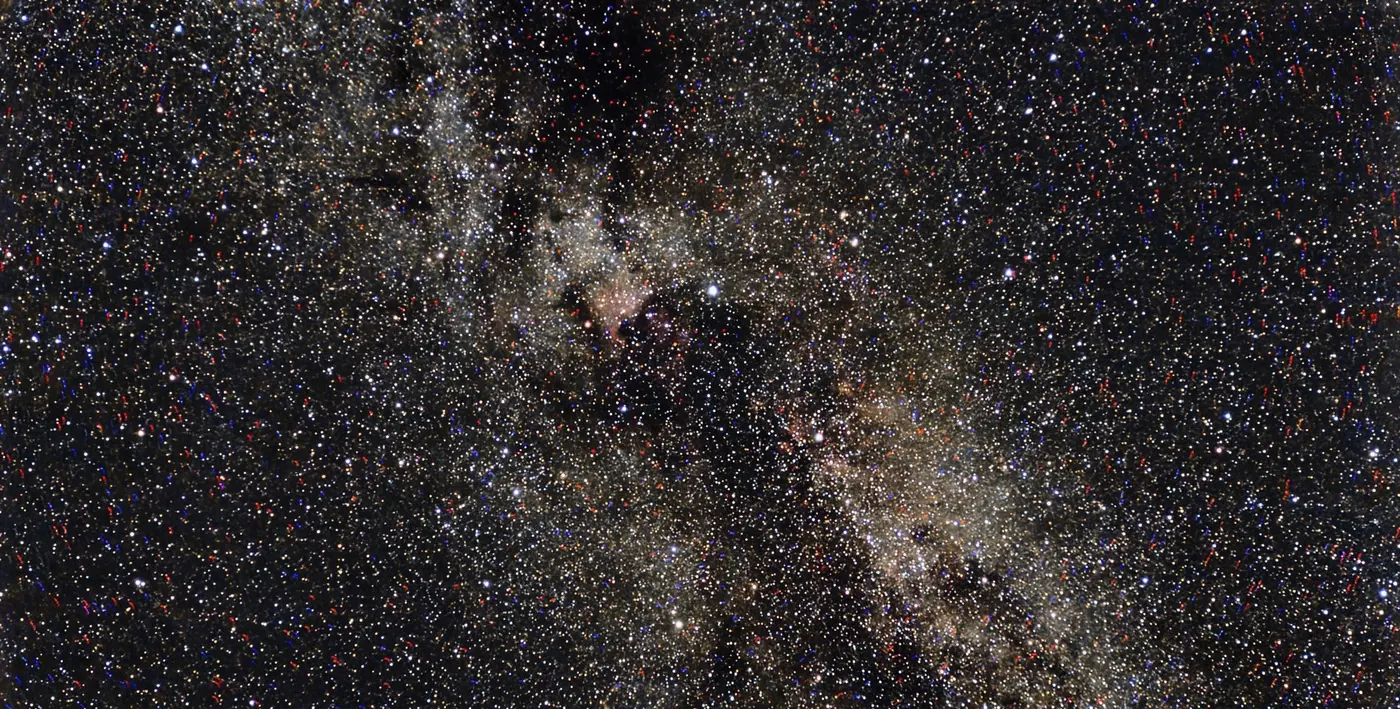
La Voie lactée · 1h 43 · DwarfLab DWARF 3
Z
- Zénith
-
The point in the sky exactly overhead, vertically above the observer, at an altitude of 90°. An object passing close to it crosses as little atmosphere as possible, and that is where it is seen best. The opposite point, beneath the feet, is the nadir.
See also Nadir