
Comparing two devices
Atlas or Draco: which to choose in 2026
I have never had either the Vaonis Atlas or the DwarfLab Draco in my hands. None of my images was made with either one. This page therefore compares nothing but specifications published by the manufacturers, sourced at the foot of the page. It will not tell you what these devices are worth in the field, because I do not know.
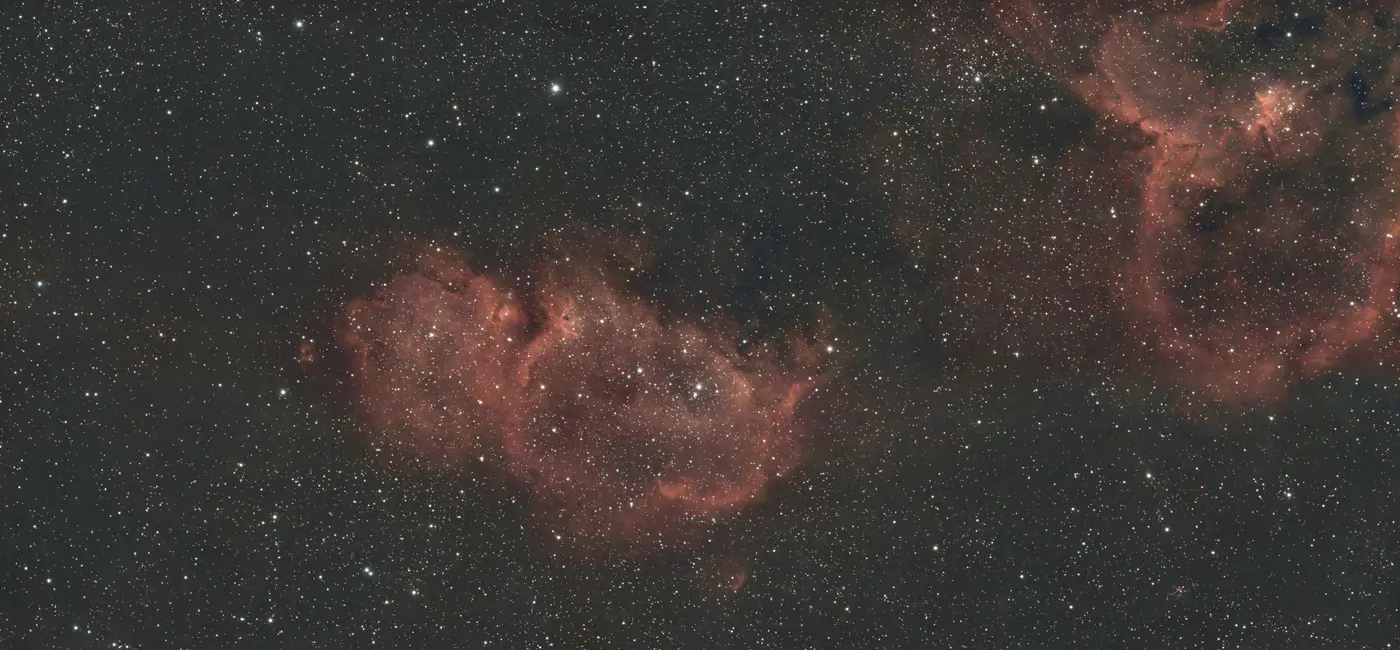
Le Cœur et l'Âme · Photograph by the author · 3h 47m of exposure, DwarfLab DWARF 3
not tested Vaonis Atlas
0 · no first-hand data
0 towards 170h · hours I have logged with this device, this is not a rating
not tested DwarfLab Draco
0 · no first-hand data
0 towards 170h · hours I have logged with this device, this is not a rating
Line by line
What the two datasheets do not say the same way
Every value comes from the entry for that device, where it carries its source. The difference column is worked out here, from those two values. It gives the size of the gap, never its direction: the two columns before it already say that. It stays empty on lines with no number. It stays empty too wherever a percentage would mean nothing.
Rapport d'ouverture : the focal length divided by the diameter, written f/, and the smaller that number, the faster the image forms. Monture azimutale : it moves in altitude and in rotation, but the field turns during the night.
| Specification | Vaonis Atlas | DwarfLab Draco | Difference |
|---|---|---|---|
| Aperture | 80 mm | 90 mm (telephoto) · 2.96 mm (wide angle) | 13% |
| Focal length | 360 mm | 340 mm (telephoto) · 5.56 mm (wide angle) | 6% |
| Focal ratio | f/4.5 | f/3.8 | |
| Sensor | Sony IMX585, format 1/1.2 inch, 11.2 × 6.3 mm, 2.9 µm photosites | OmniVision OV50Q40 (telephoto, 1/1.3 inch) · OV50E40 (wide angle) · OS04C1B monochrome (guiding) | |
| Resolution | 3,840 × 2,160 px (8.3 Mpx) | 12 Mpx output, by 2 × 2 binning on a 50.33 Mpx sensor | |
| Built-in filters | None · 1.25 inch filter drawer, automatically recognised Vaonis filters announced for late 2026 | Telephoto: Astro, dark filter, dual-band Hα + O III, and solar neutral filter (standard edition) or dual-band S II + O III (SHO edition). Wide angle: VIS, neutral filter | |
| Mount | Motorised altazimuth · equatorial table announced for the second half of 2027 | Altazimuth with field derotator, equatorial mode supported | |
| Weight | 6.5 kg (Single, mount 3.5 kg and imaging module 3 kg, sum of the two published masses · Twin 9.5 kg) | 5.5 kg | 18% |
| Software | Gaia (iOS, Android) | DWARFLAB (iOS, Android) | |
| Indicative price | ≈ €4,990 (≈ €3,990 at the launch price until 15 November 2026 · Twin ≈ €6,990, ≈ €5,490 at the launch price) | ≈ €1,669 (SHO edition, the only one available · standard edition ≈ €1,499, sold out as recorded on 14 September 2026) | 3 times |
Prices recorded in 2026, excluding promotions and accessories. The Vaonis Atlas and DwarfLab Draco entries each carry their own sources, one per specification.
What the data settles
Four differences, and nothing more
-
01
The price. The cheaper is the DwarfLab Draco, at ≈ €1,669. The Vaonis Atlas asks ≈ €4,990, which is 3 times more. These are market prices, recorded in 2026 from the sources cited at the foot of the page. They are not my selling prices.
-
02
The diameter. The Vaonis Atlas opens at 80 mm. The DwarfLab Draco opens at 90 mm, which is 13% more. Diameter commands resolution, the finest detail that can come out of the exposure, whatever its length.
-
03
The time it takes. DwarfLab Draco is the faster of the two, f/3,8 against f/4,5. Le Draco makes in 1h an image that takes 1h 24m à l'Atlas.
-
04
The weight. The DwarfLab Draco weighs 5,5 kg. The Vaonis Atlas weighs 6,5 kg, which is 18% more. Weight says nothing about image quality: it says what you can carry.
These lines read published specifications and hours actually logged. They do not rank the two devices and do not rate their quality. An empty track is a device that was not tested, not a bad device. The exposure equivalence compares nothing but the published focal ratios, with sensor, sky and target held identical. It says nothing about resolution, about the field, or about optical quality.
The two devices
Their strong points, and their weak points
Vaonis · ≈ €4,990
Vaonis Atlas
One mount, and 80 mm imaging modules that fix onto it without tools: one to start with, two on the same target to double the light. Alongside the all-in-one Vesperas, Vaonis offers an instrument you can upgrade.
Strong points
- 80 mm of aperture against 50 on the Vesperas: 2.56 times more area to gather light, by calculation on the two published diameters.
- Modular: the imaging module fixes onto the mount through the Sky Dock interface, without tools and in under five seconds according to Vaonis. A second 80 mm module can be added later, and a planetary module is announced.
- In Twin, two modules aim at the same target and the app stacks their images: Vaonis quotes twice the light and a signal-to-noise ratio about 41% higher. The field stays that of a single module.
- Sky Guard, a 185° fisheye camera housed in the mount, films the whole sky live. You touch an object in that image, the Atlas points at it, and it finds the horizon, the Sun and the Moon on its own to initialise.
- Four lenses in three groups, with no mirror and no central obstruction. According to the optical calculations Vaonis publishes, the blur due to the lenses stays smaller than the unavoidable blur of diffraction (2.9 µm radius), from the centre to the edge of the sensor.
- Die-cast aluminium structure, rated IP64, usable from -20 to +40°C. Vaonis quotes the Vesperas in ABS, rated IP43.
- A ten year warranty on the mount and five years per module, against five years on the Vesperas. Aluminium tripod and carrying bag supplied with both configurations.
Weak points
- About €4,990 in Single, and €3,990 at the launch price valid until 15/11/2026: the most expensive in the panel after the Origin, and €2,000 more than the Vespera Pro 2.
- 6.5 kg in Single and 9.5 kg in Twin, tripod not included: the heaviest of the Vaonis devices compared here, against 5 kg for the Vesperas.
- The first deliveries are planned for March 2027. All the published sky images come from Vaonis, and no independent review had appeared when recorded on 21/10/2026.
- No built-in filter, only a drawer in the 1.25 inch format. The automatically recognised Vaonis filters and the solar filter are only announced for late 2026.
- No equatorial mode before the equatorial table, announced for the second half of 2027 with no published price. Vespera accessories do not fit: Vaonis writes so in its FAQ.
- Six hours of battery, against eleven on the Vespera 3 and Pro 2. Storage goes onto a microSD card, and no internal capacity is published.
- A native field of 1.78° by 1.00°, narrower in both directions than that of the Vespera 3, 2.5° by 1.4°. The mosaic goes up to 32 Mpx, against 50 on the Vespera Pro 2.
DwarfLab · ≈ €1,669
DwarfLab Draco
90 mm in a 5.5 kg body, with a sensor that turns on itself to cancel out the rotation of the sky. DwarfLab leaves the small format behind and aims at the portable observatory.
Strong points
- 90 mm of aperture: the largest diameter of the devices compared here after Celestron's Origin and Unistellar's eQuinox 2.
- f/3.8, and it is DwarfLab that writes it: after the Origin, the fastest ratio in the panel for a single optic, level with the Odyssey. So it gathers light more quickly.
- A field derotator, quoted at between 0.001 and 12.83 degrees per second. Neither the DWARF 3 nor the DWARF mini has one: their entry carries the word none.
- Sub-exposures up to 300 s, against 60 s on the DWARF 3.
- Dual-band filter narrowed to 13 nm on each line, against 20 and 12 nm on the DWARF 3.
- The SHO edition adds a second dual-band filter for sulphur and oxygen, and runs through both filters on its own to compose an image in the Hubble palette.
- Ethernet over USB and remote control: it will let itself be set up under a better sky than its owner's.
Weak points
- 5.5 kg: this is no longer the rucksack format of the other DwarfLabs. The DWARF 3 weighs 1.35 kg.
- It costs about three times the price of a DWARF 3.
- The sensor holds 50.33 Mpx but delivers only 12 on the deep sky, by grouping the pixels four by four.
- Five hours of battery only, against eleven on the Vespera 3 and nine on the Seestar S50 Pro.
- The standard edition was sold out when recorded on 14/09/2026, and the SHO edition is sold on pre-order.
- DwarfLab quotes shipping within three months of the order. No real image from use exists yet.
Getting hold of one
These two devices, you can order them here
There is no basket and no online payment. You say which one interests you. You can also describe what you want to photograph, and from what sky. The answer comes in writing: a price, a lead time, and what the device can and cannot do. If neither of the two suits, it will say so, and it will say which one suits better.
The prices shown on this page are market prices recorded in 2026 from the sources below. They are not selling prices, and they do not constitute an offer. Your price, your lead time and availability appear in the written reply.
Sources
Where these figures come from
- Vaonis, fiche technique de l'Atlas · Vaonis Atlas
- Vaonis, fiche boutique de l'Atlas, Single et Twin, prix de lancement et précommande · Vaonis Atlas
- Vaonis, page de présentation de l'Atlas en anglais · Vaonis Atlas
- Vaonis, tableau officiel de comparaison des modèles (application Gaia, iOS et Android) · Vaonis Atlas
- PetaPixel, annonce de l'Atlas du 15/10/2026 · Vaonis Atlas
- DWARFLAB, fiche produit Draco · DwarfLab Draco
- DWARFLAB, page de présentation du Draco · DwarfLab Draco
No value on this page is estimated. The differences are worked out from the values above. The focal ratio, for its part, is recalculated from the published aperture and focal length. A specification wrong or out of date? Report it.